The Vanishing Divide: What Was Lost When the Console Became a Wall
For most of automotive history, the transmission tunnel was a minor inconvenience that passengers simply stepped over. A modest hump running the length of the cabin floor, it was the unavoidable consequence of housing a driveshaft or a gearbox beneath the occupants. Passengers on bench seats slid toward the center when the road curved sharply. Couples on long drives sat close enough to touch. Children migrated freely from one side of the rear seat to the other. The tunnel was a physical fact, but it was not a barrier.
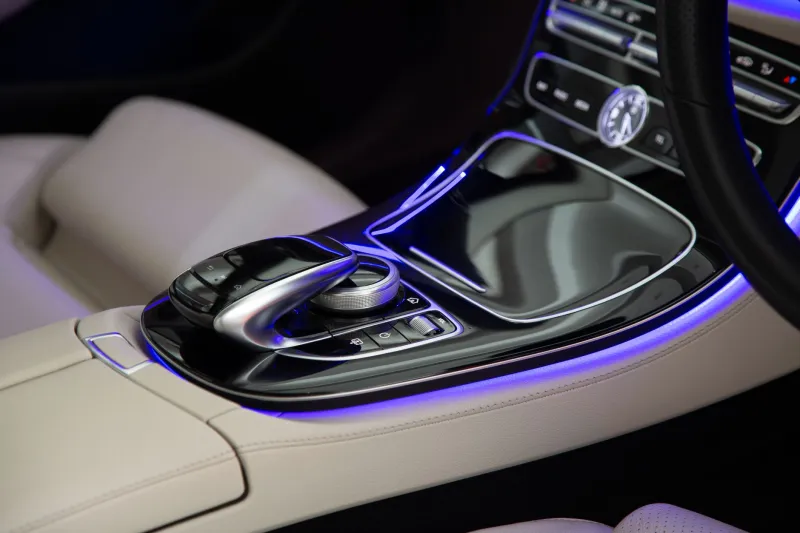
Something has changed. In the modern performance car and luxury grand tourer, the center console has grown from a modest storage solution into a commanding architectural feature—a raised, sculpted, screen-laden structure that rises to shoulder height between driver and passenger and establishes, with the authority of a partition, that these are two separate experiences happening in close proximity rather than one shared experience happening together.
The implications for grand touring—a pursuit that has always been as much about companionship as about distance—deserve a more serious examination than the design community has yet offered.
A Brief History of Proximity
The bench seat, which dominated American automotive interiors well into the 1970s and persisted in many configurations through the 1980s, was not simply a cost-saving measure, though it was that too. It was a social architecture. It placed the passenger in genuine physical proximity to the driver, close enough for conversation conducted at a normal register, close enough for the kind of unconscious physical contact—a hand on an arm, a shoulder leaning into a turn—that reinforces the sense of shared experience.
The transmission tunnel in these cars was present but modest. In front-engine, rear-wheel-drive configurations, it accommodated the driveshaft and, in manual variants, the shifter. Passengers straddling it were mildly inconvenienced. The tunnel did not divide so much as it slightly elevated the center position, which in many American families became the default seat for the youngest child.
The transition to bucket seats, which arrived in earnest with the performance car movement of the 1960s, introduced a more deliberate separation between driver and passenger. This was, in part, a functional choice: bucket seats provide lateral support that bench seats cannot, and lateral support matters when a car is driven with any ambition. But the bucket seat also carried a philosophical implication. It said: the driver is doing something distinct from what the passenger is doing. The driver is operating. The passenger is riding.
This distinction, which made sense on a circuit or on a demanding mountain road, was subsequently applied wholesale to vehicles that would spend the majority of their lives on interstate highways, where the distinction between operating and riding is largely theoretical.
The Console as Cultural Artifact
The modern center console did not simply grow by accident. It grew in response to genuine demand—for storage, for USB ports, for wireless charging pads, for the kind of organizational infrastructure that contemporary life requires. It also grew because designers discovered, perhaps correctly, that a substantial console communicates a sense of premium quality in a way that a flat floor does not. Mass and materiality read as luxury in showroom evaluations.
But the console also grew because the automobile industry, consciously or not, accepted a fundamental redefinition of what a passenger cabin is for. The contemporary cabin, as conceived by most manufacturers, is a personal device environment: a space where each occupant manages their own digital experience, their own climate zone, their own audio feed. The console does not merely separate driver from passenger physically. It provides the infrastructure for their parallel but independent consumption of the journey.
This is a coherent vision of automotive experience. It is not, however, a grand touring vision.
Grand touring, as a tradition and a philosophy, has always assumed that the journey itself is the point—not the destination, and not the individual occupant's management of their personal entertainment queue. The great grand tourers of the postwar European tradition were designed to facilitate conversation, to encourage the kind of sustained, unhurried engagement between driver and passenger that long distances make possible. The cockpit was intimate by design. You were in it together.
What the Road Trip Lost
Ask anyone who came of age in an American family that took serious road trips in the 1970s or 1980s what they remember most vividly, and the physical experience of the car interior will almost certainly feature in the answer. The particular quality of being close to one another in a moving space, separated from the ordinary geography of home, created a conversational intimacy that was genuinely difficult to replicate elsewhere.
This is not nostalgia dressed as analysis. The environmental psychology of enclosed spaces is well-documented: physical proximity, combined with the mild sensory novelty of moving through landscape, produces a conversational openness that stationary environments tend to suppress. The car was, for many American families and couples, the place where the important conversations happened—not because they planned them there, but because the conditions made them possible.
The towering console does not merely reduce physical proximity. It provides a ready alternative to conversation. It offers, at the touch of a screen, an escape from the shared experience into a private one. This is precisely what the best grand touring has always resisted: the substitution of individual consumption for shared presence.
A Different Kind of Efficiency
The automotive industry's defense of the modern console architecture is, at its core, an efficiency argument: more storage, better ergonomics, improved access to controls, optimized charging infrastructure. These are real benefits. They are also entirely beside the point when evaluated against what they have cost.
Some manufacturers have recognized this tension and responded to it with varying degrees of commitment. Certain grand touring configurations still offer relatively modest console structures, and the occasional front bench seat persists in the American market, primarily in full-size trucks and a handful of luxury sedans. But these are exceptions, and they are shrinking.
The transmission tunnel was never the problem. It was a mechanical necessity that, in its modest original form, asked very little of the people living with it. What replaced it—the console as command center, the cabin as individual device ecosystem—asks something far more significant in return: the willingness to be genuinely together in a car, for the duration of a real journey, has become an act that the modern interior no longer supports by default.
For those who take grand touring seriously, this represents a loss worth naming clearly. The road has not changed. The distances have not shortened. The conversations that long drives make possible remain as valuable as they ever were. The cars, however, have quietly stopped making room for them.