The View From the Outside: What Corner Workers See That Drivers Never Do
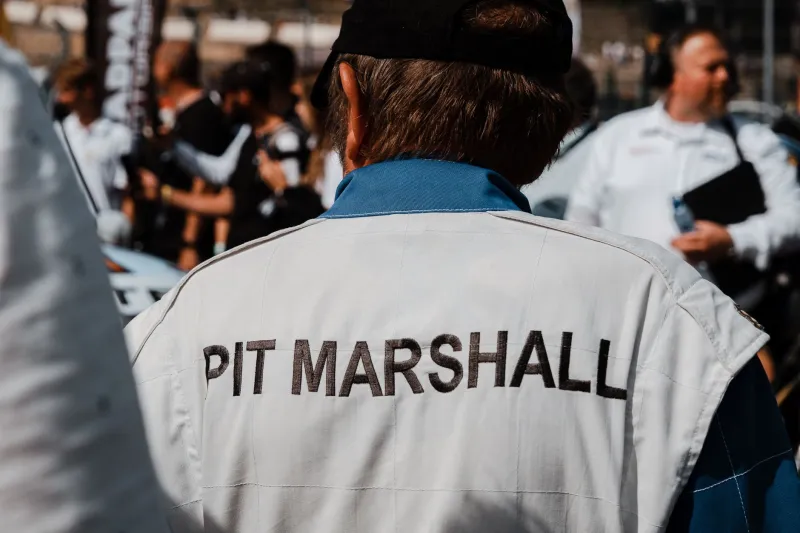
The station sits at the outside of a turn most drivers will never name. There is a wooden platform, a set of flags in a canvas bag, a fire extinguisher, a radio, and a folding chair that has seen better seasons. By seven in the morning the worker is already there, because the first session goes green at eight and the station must be staffed before a single car turns a wheel.
American club racing and track-day culture runs on these people. The Sports Car Club of America, the National Auto Sport Association, and the various marque clubs all depend on volunteers who give up weekends to stand at the edge of the pavement. They are not paid. They are not celebrated. They are, in a real sense, the reason anyone else is allowed to drive quickly at all.
The Station and the Sweep
A corner worker's job begins with observation. Each station is assigned a sector of track, and the worker learns its rhythms: where cars tend to run wide, where the pavement changes character, where a curb invites an ambitious line, where oil from a blown engine is likely to appear. The radio connects the station to race control, and the flag signals connect the station to the drivers.
From the outside of the fence, the view is entirely different from the cockpit. A driver sees the turn from the inside of a helmet, framed by the next apex. A worker sees the whole approach, the entry, the mid-corner attitude, and the exit, along with the car ahead and the car behind. That wider frame is what makes their perspective worth seeking.
Braking, Seen From a Distance
Ask a corner worker about braking and the answer is rarely about how late a driver goes. It is about consistency. From a fixed vantage point, session after session, a worker can see whether a car arrives at the braking zone at the same place every lap. A driver who brakes ten feet earlier but repeats it precisely is easier to read, and generally faster over a stint, than one who occasionally nails a spectacularly late stop and misses the next three.
The same view reveals what late braking costs. A car that arrives too hot often carries the mistake through the corner: a tightened line, a correction at the apex, a delayed throttle. The worker sees the chain of consequences that the driver experiences only as a vague sense of untidiness.
Flags as a Language
Flag protocol is a discipline in itself. The yellow flag is not merely a warning; it is an instruction with a defined meaning and a defined duration. The blue flag asks a slower car to yield to a faster one, and it is a request rather than an entitlement. The black flag summons a car to the pits, and the meatball flag indicates a mechanical problem that requires attention.
Workers learn to read the intent behind the signal as well as the signal itself. A driver who acknowledges a blue flag promptly and predictably is a driver the whole system can trust. A driver who ignores it creates a risk that everyone at the station can see developing and no one can prevent.
Etiquette and the Point-By
At track days, the point-by is the currency of the day. A driver who lifts slightly and extends a hand out the window signals that the following car may pass on the indicated side. Done well, it is elegant. Done late or ambiguously, it is the source of most of the frustration that workers witness.
From the outside, the pattern is clear. The most respected drivers on any given day are not always the fastest. They are the ones who signal early, hold a predictable line, and leave room. Workers notice because they see the same cars interact with the same traffic over and over, and the courteous ones make the entire session safer for everyone.
Risk, Measured in Seconds
Corner workers are trained to respond to incidents, but their greater value lies in anticipating them. They watch for the car that has begun to miss its line, the driver whose inputs have become abrupt, the machine that is leaving a faint trail of smoke or fluid. A worker who calls a problem on the radio before it becomes an incident has done the most valuable thing the role allows.
That perspective produces a particular kind of humility. Workers see how quickly a small error compounds, and they see how rarely the dramatic moments are truly sudden. Most incidents announce themselves in advance to anyone watching from a fixed point with nothing else to do.
What This Teaches the Grand Tourer
The lessons transfer directly to the road. A grand touring driver who values consistency over heroics, who leaves margin in reserve, and who reads traffic several cars ahead is practicing the same discipline the corner worker observes every weekend. Mechanical sympathy, predictable inputs, and a willingness to be passed without ego all come from the same place.
There is also a practical courtesy that carries over. The worker who stands in cold rain so that someone else can drive quickly is a reminder that fast driving is a shared activity with unspoken obligations. On a mountain road or an interstate, the same obligations apply, even when no one is holding a flag.
The Quiet Authority
The next time a track day or club race appears on the calendar, consider walking to the outside of a corner and watching for twenty minutes. The view is not glamorous, and the company is likely to be someone in a weathered jacket with a thermos. But that person understands speed in a way that is difficult to acquire from the driver's seat, and the understanding is offered freely to anyone willing to stand beside them and learn.