Sacred Ground: Inside the Private Collections Preserving America's Grand Touring Soul
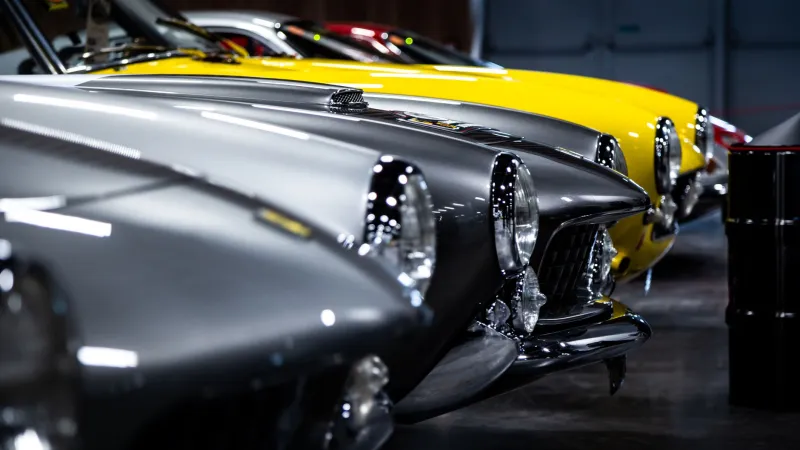
There is a particular quality of light inside a serious collector's garage — something between reverence and electricity. The fluorescent tubes overhead do their practical work, but the real illumination comes from the machines themselves. Chrome catches the glare. Paint depths shift as you move. A leather interior exhales decades of memory. These are not showrooms. They are not museums. They are something considerably more personal than either.
Across the United States, a dispersed community of collectors has assembled private holdings that represent, in aggregate, one of the most significant archives of grand touring culture anywhere in the world. Unlike the institutional collections at the Petersen Automotive Museum in Los Angeles or the Henry Ford in Dearborn, these garages exist outside public view, shaped entirely by individual obsession, financial sacrifice, and a philosophy about what high-performance driving actually means. Grand Tourismo spent several months visiting some of these collections, speaking with their owners about curation, consequence, and the machines they cannot imagine parting with.
The Philosophy Before the Purchase
Every serious collection begins with a governing idea, whether its owner articulates it explicitly or not. For Marcus Heller, a retired aerospace engineer who maintains fourteen vehicles across a climate-controlled facility outside Scottsdale, Arizona, the organizing principle arrived fully formed during a 1987 road trip from Chicago to Santa Fe in a borrowed Porsche 928 S4.
"That car explained something to me that I hadn't understood before," Heller says, standing beside the very 928 he eventually tracked down and purchased eighteen years after that formative drive. "It wasn't the fastest thing on the road. It wasn't even the most dramatic. But it made every mile feel deliberate. That's what I've been chasing ever since — machines that reward engagement rather than just rewarding speed."
Heller's collection reflects that conviction with remarkable consistency. Alongside the 928 sit a 1971 Ferrari 365 GTC/4, a first-generation Acura NSX acquired new and never modified, a 1967 Jaguar E-Type Series 1 coupe, and a 2004 Ford GT purchased at original retail price from a dealer who honored the agreement despite the immediate secondary market frenzy. Each car, regardless of provenance or value, earns its place by satisfying the same criterion: it must change the quality of a long drive.
"I've turned down cars worth far more than anything in here," Heller explains. "If I can't imagine taking it from Phoenix to Sedona on a Tuesday morning just because I want to, it has no business being in this garage."
The Restorative Impulse
Not every collector arrives at their holdings through acquisition alone. In rural Vermont, Catherine Moorfield has spent the better part of two decades restoring American grand touring machines to standards that frequently surpass their original factory condition. Her current inventory includes a 1963 Studebaker Avanti, a 1970 Dodge Challenger R/T SE, and — the crown jewel of the collection by any measure — a 1969 Chevrolet Corvette L88 coupe that required four years and a level of forensic research she describes without exaggeration as "borderline obsessive."
"The L88 came to me as a shell," Moorfield recalls. "Previous owners had stripped it, repainted it incorrectly, and installed an engine that had nothing to do with the original. Bringing it back meant understanding exactly what the factory did in the spring of 1969, down to the specific torque sequences used on the intake manifold bolts."
What distinguishes Moorfield's approach is her insistence that restored vehicles remain drivers. The Corvette has attended three Concours d'Elegance events, earned recognition from the National Corvette Restorers Society, and has also covered approximately four thousand miles since its restoration was completed. She is unapologetic about this.
"A car that only sits is a car that's already halfway gone," she says. "These machines were built to travel. Keeping them perfect by keeping them still seems like a profound misunderstanding of what they are."
Cross-Country Provenance
Few aspects of a private collection carry more weight than documented history — the paper trail that confirms not merely what a car is, but where it has been and who has guided it. In the Pacific Northwest, outside Portland, Oregon, retired attorney David Sung has assembled a collection of eleven vehicles unified almost entirely by verifiable American road history. His 1955 Mercedes-Benz 300SL Gullwing, imported new by a Seattle physician, has service records from 1955 through 1991. His 1967 Shelby GT500 was delivered to a San Francisco dealership, purchased by a musician whose name Sung declines to share, and driven along the California coast for six consecutive summers before changing hands.
"Provenance isn't about value," Sung explains, though he acknowledges the correlation is undeniable. "It's about continuity. When I drive the 300SL, I'm participating in something that started sixty-nine years ago. That's not a metaphor. The same mechanical systems that carried a doctor through the Cascades in 1957 are carrying me today. That relationship is worth protecting."
Sung's curation process is accordingly rigorous. He has declined vehicles with superior specifications and lower mileage when the documentation trail proved incomplete. He has also, on two occasions, purchased cars in significantly worse condition than available alternatives specifically because their histories were intact and traceable.
What the Collections Reveal
Spent across the garages of Heller, Moorfield, Sung, and the dozen other collectors Grand Tourismo visited during this project, a consistent portrait emerges — not of wealth or status, but of a particular relationship with motion and meaning. These collectors are not primarily investors, though several hold assets of considerable financial value. They are not nostalgists in the dismissive sense, though they care deeply about the past. They are, in the most precise sense of the term, grand tourers: people for whom the act of covering significant distance in a purposeful, beautifully engineered machine constitutes something close to a philosophical practice.
The machines they keep are the physical evidence of that practice — each one a record of decisions made by engineers and designers who believed that the experience of driving could be elevated into something approaching art. That these collectors have assumed responsibility for preserving those decisions, often at considerable personal expense and with no expectation of public recognition, represents a form of cultural stewardship that deserves acknowledgment.
The Ongoing Obligation
Every collector interviewed for this piece expressed some version of the same sentiment: the cars are not truly theirs. They are custodians, temporary guardians of machines whose stories began before them and will, ideally, continue long after.
"My job is to hand these on in better condition than I received them," says Heller, gesturing across a garage that has consumed a substantial portion of his retirement savings and an incalculable portion of his waking attention. "Not better in the sense of more restored or more pristine. Better in the sense of more understood. More documented. More driven."
It is a philosophy that resonates deeply with the grand touring tradition itself — the understanding that the road is not a backdrop but a collaborator, and that the machines built to travel it deserve companions who take the relationship seriously. In garages from Arizona to Vermont to Oregon, those companions are doing exactly that, one extraordinary mile at a time.