Grip Before Glory: The Forgotten Discipline That Separates True Grand Tourers From Mere Muscle
There is a particular kind of silence that falls over a conversation when you suggest, to a room full of American horsepower enthusiasts, that power figures are largely beside the point. The discomfort is palpable. In a culture that has long measured automotive virtue in quarter-mile times and dyno readouts, the notion that restraint could be a greater engineering achievement than outright force feels almost heretical. And yet, every driver who has ever pushed a truly great grand tourer through a sweeping mountain highway knows the truth: it is the chassis, not the crankshaft, that makes the machine.
This is not an argument against power. It is an argument for context.
The Foundation Beneath the Fury
The grand touring tradition was never conceived around straight-line supremacy. Its origins lie in the long-distance European drives of the postwar era—journeys that demanded a machine capable of sustained composure across hundreds of miles, through varying road surfaces, shifting weather, and the accumulated fatigue of genuine distance. The great touring cars of that period were celebrated not because they were the fastest things on the road, but because they were the most capable over the full breadth of a journey.
Porsche understood this perhaps more instinctively than any other manufacturer. The 911, in its earliest iterations, was not a car that overwhelmed its driver with power. It was a car that demanded a conversation—a precise, sometimes difficult dialogue between driver inputs and chassis response. The engineers in Stuttgart spent decades refining that conversation, not by adding displacement, but by perfecting geometry. Suspension tuning, weight distribution, steering feedback: these were the obsessions that defined the marque. The result was a machine that rewarded skill rather than simply amplifying throttle inputs.
BMW pursued a parallel philosophy from Munich. The E34 M5, the E39 M5, the early iterations of the M6—these were not the most powerful cars in their respective market segments. They were, however, among the most precisely engineered. The M division's mandate was always balance first, power second. A chassis that communicated honestly, a suspension calibrated to absorb without isolating, a steering rack that conveyed information rather than filtering it away. The power was present, certainly, but it existed in service of a broader dynamic harmony.
When Numbers Become a Distraction
The contemporary tuning culture that has flourished across American automotive communities operates on a fundamentally different set of values. The pursuit of four-digit horsepower figures, the celebration of tire-shredding launches, the modification hierarchies built around dyno sheets—these represent a genuine enthusiasm for automobiles, but one that has become increasingly disconnected from the disciplines that produced the cars being modified.
Professional driver and driving coach Jonathan Hargrove, who has logged thousands of instructional miles at venues including Laguna Seca and Virginia International Raceway, describes the phenomenon with characteristic directness. "The students who come in convinced that their power modifications have made them faster are almost always the most difficult to work with," he notes. "They've optimized for the wrong variable. When you put them in a car with half the horsepower but a properly sorted chassis, they're slower. It takes real humility to accept that the car isn't the problem."
Hargrove's observation points to something deeper than driving technique. It speaks to a fundamental misunderstanding of what makes a performance automobile genuinely capable. Horsepower, beyond a certain threshold, becomes exponentially more difficult to deploy effectively. A car producing 800 horsepower on street tires, in real-world conditions, is not twice as fast as a car producing 400 horsepower. It is, in most circumstances, significantly more difficult to manage—and therefore slower in the hands of any driver operating below the absolute elite tier of skill.
The Mercedes Standard
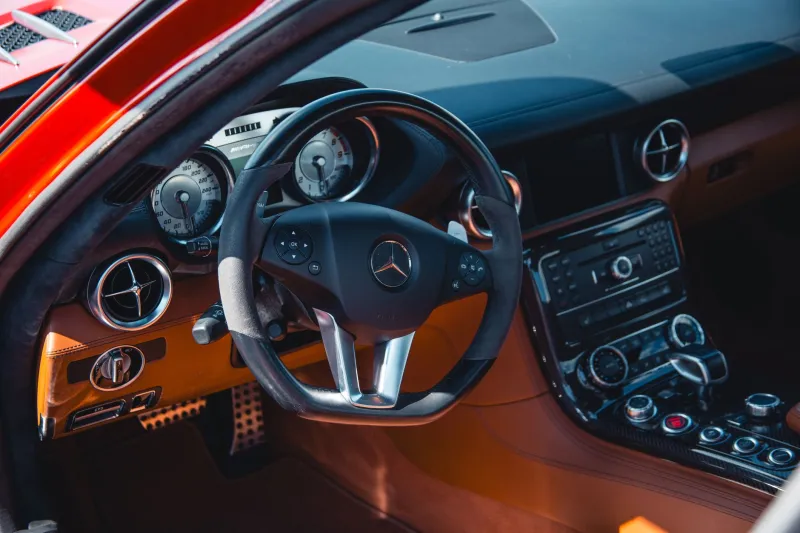
Mercedes-Benz offers perhaps the most instructive case study in the tension between power and refinement. The AMG division's recent trajectory—toward increasingly massive power outputs, active aerodynamic systems, and electronically managed torque vectoring—represents one legitimate response to the question of how to make a large, heavy grand touring automobile perform. But the cars from an earlier AMG era, the E55 and E63 of the mid-2000s, are remembered with particular affection by serious enthusiasts not because of their power figures, but because of their analog coherence.
Those machines possessed a quality that is increasingly difficult to quantify in an era of algorithmic chassis management: they felt honest. The suspension communicated road texture. The steering, though hydraulically assisted, transmitted information. The driver occupied a position of genuine authority over the machine, rather than serving as a supervisory presence over a network of electronic interventions. That honesty, that willingness to share the truth of the road with the person behind the wheel, is the essence of grand touring character.
Restraint as Sophistication
There is a maturity required to appreciate engineering restraint. It is, in some respects, easier to be impressed by a car that overwhelms the senses—that pins occupants to their seats, that announces its presence through theater and excess. The more demanding appreciation is for a machine that does everything with quiet authority, that arrives at extraordinary outcomes through precision rather than brute application.
This is the standard against which genuine grand tourers have always been measured. Not by what they do at maximum effort, but by what they do across the full spectrum of conditions and demands. A car that is magnificent at ten-tenths but unpleasant at seven-tenths has failed the grand touring brief. The discipline requires competence across the entire range.
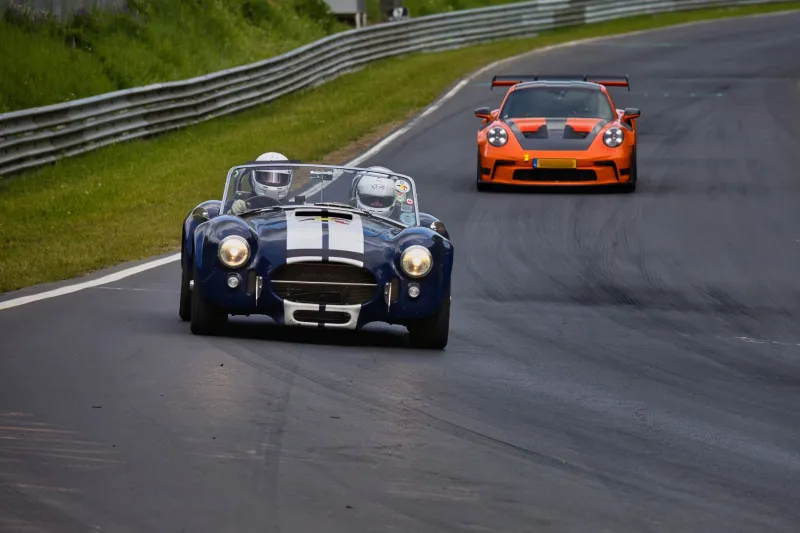
Track data supports the philosophical argument. Lap time analyses conducted at closed-course events consistently demonstrate that chassis balance and mechanical grip contribute more to overall pace than additional power, particularly for drivers operating below professional levels. A properly suspended, accurately aligned, well-damped automobile will outperform a more powerful but dynamically compromised machine in the hands of the same driver, across virtually any road course of meaningful complexity.
The Road Demands More Than Muscle
The American road, in its finest expressions—the Pacific Coast Highway threading along the California cliffs, the Blue Ridge Parkway ascending through the Appalachians, the empty two-lanes of the Texas Hill Country—does not reward horsepower in isolation. It rewards the complete machine. The car that can be placed precisely, that responds to corrections with immediate fidelity, that maintains composure when the surface deteriorates or the corner tightens unexpectedly.
This is the standard that the grand touring tradition established, and it remains the standard against which every serious machine should be evaluated. Power matters. But power without the engineering infrastructure to deploy it purposefully is, in the end, simply noise—impressive in the moment, forgettable over distance.
The road, as it always has, eventually reveals the difference.