The Art of the Cockpit: Why Interior Craft Defines the True Grand Tourer
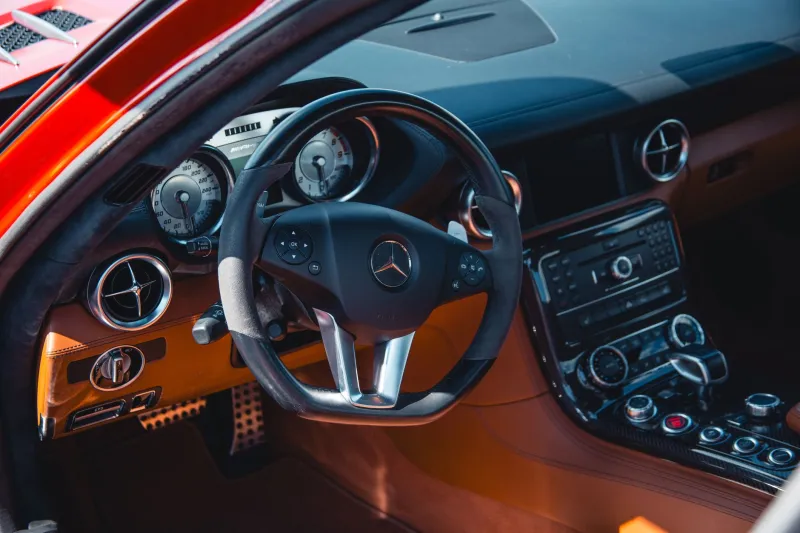
There is a particular moment, familiar to anyone who has ever settled into the seat of a truly accomplished grand tourer, when the outside world recedes. The door closes with a sound that is less mechanical event than architectural statement. The leather—whether it carries the faint sweetness of a Connolly hide or the cool precision of a modern Nappa tanning—meets the hands with an authority that no specification sheet can adequately describe. And before the engine is even invited to speak, the driver already understands that something significant is about to happen.
This is the cockpit philosophy, and it is the animating principle behind every great grand touring machine ever built.
Power Is Easy. Presence Is Not.
The American automotive conversation has long been conducted in the language of power. Horsepower, torque, zero-to-sixty times—these are the metrics that dominate press releases and fuel forum debates from coast to coast. And in isolation, none of them are irrelevant. A grand tourer without meaningful performance reserves is simply a comfortable automobile.
But consider what happens when two cars of equivalent output are placed side by side. One fills its interior with soft-touch plastics that mimic substance without possessing it, with a steering wheel that communicates nothing beyond the mechanical fact of turning, with seats that position the driver rather than embrace them. The other wraps its occupants in hand-stitched leather, offers a wheel whose rim diameter and cross-section were chosen through decades of accumulated ergonomic wisdom, and presents controls so logically arranged that they seem to anticipate intention rather than merely respond to it.
The second car does not need to be faster. It already feels faster, because it has made the driver feel capable, present, and connected in ways that the first machine never could.
The Steering Wheel as Instrument
No single element of cockpit design carries more communicative responsibility than the steering wheel, and no single component is more frequently compromised in the pursuit of cost efficiency or aesthetic novelty.
The great marques have always understood this. Porsche's decision to maintain a relatively modest wheel diameter across generations of its grand touring lineup was not conservatism—it was philosophy. A smaller wheel demands greater precision from the driver while delivering more immediate feedback from the road surface. It transforms the act of steering from a directional instruction into a continuous conversation.
Ferrari, for its part, has spent decades refining the relationship between rim thickness, spoke architecture, and the placement of secondary controls. The goal is never merely to make the wheel look impressive in a press photograph. The goal is to ensure that a driver three hours into a run from Los Angeles to Palm Springs can still read the road through their palms as fluently as they could at the first mile.
Bentley approaches the same problem from an entirely different direction, prioritizing the tactile richness of the material itself—the depth of the leather, the temperature it holds, the way it ages with use—over any particular geometric specification. Both philosophies are legitimate. Both reflect a coherent understanding of what the cockpit is for.
Ergonomics as Endurance
Grand touring, by definition, involves distance. A machine that cannot be inhabited comfortably across six, eight, or ten hours of continuous driving has failed at the most fundamental level of the discipline, regardless of what its dyno sheet claims.
This is why seat design in the finest grand tourers is an engineering undertaking of genuine seriousness. The lateral bolsters must hold the driver securely through cornering without generating fatigue during extended straight-line cruising. The lumbar support must be adjustable with sufficient granularity to accommodate the subtle postural shifts that accumulate over a long day behind the wheel. The headrest must position the driver's sightline correctly without creating the neck tension that plagues so many otherwise accomplished sporting seats.
Aston Martin's ongoing refinement of its front seat architecture across successive DB generations represents one of the more instructive case studies in this discipline. Each iteration has sought to resolve the fundamental tension between sporting hold and touring comfort, and each has moved the needle incrementally in both directions simultaneously—a feat that requires not just engineering competence but a genuine philosophical commitment to the grand touring mission.
The Infotainment Question
No aspect of modern cockpit design generates more passionate disagreement among serious enthusiasts than the integration of digital interfaces. The debate is understandable. A large touchscreen positioned at the center of an otherwise analog, craft-focused environment creates an obvious visual and philosophical tension.
The marques that have navigated this tension most successfully are those that have treated digital integration as a cockpit design problem rather than a technology problem. The question is never simply what the screen can do. The question is where it lives in the hierarchy of the driver's attention, how its illumination behaves at night, whether its haptic responses feel commensurate with the quality of every other surface in the cabin, and whether its presence diminishes or enhances the sense of purposeful enclosure that defines the great cockpit.
Porsche's approach with the current Panamera and 911 Turbo lines—retaining a meaningful complement of physical controls alongside a central display, rather than surrendering the entire fascia to glass—reflects an understanding that the driver's hands and eyes are finite resources that must be managed, not merely accommodated.
Why Enthusiasts Are Voting With Their Wallets
The market evidence for the primacy of interior quality is no longer anecdotal. Across the American collector and enthusiast community, vehicles with exceptional cabin execution consistently command premiums that outpace their performance specifications alone would justify.
A used Bentley Continental GT with a worn but honest leather interior will hold its value against a higher-output competitor whose cabin feels plasticky and transient. A Maserati GranTurismo—never the most potent machine in its segment—retains devoted ownership communities precisely because its interior, with its Poltrona Frau leather and its instrument binnacle that reads like a piece of Italian furniture, delivers an experience that pure performance metrics cannot replicate.
This is the cockpit philosophy made manifest in the marketplace: enthusiasts who understand grand touring understand that they will spend more time feeling their car than measuring it. And they invest accordingly.
The Immersion Imperative
At its most essential, the cockpit philosophy is an argument about immersion. A grand tourer's interior is not a passenger space that happens to contain a driver. It is an environment engineered to make the act of driving feel like the most natural and rewarding thing a human being can do with their time.
When that environment is executed with genuine craft—when the materials are honest, the ergonomics are considered, the controls are positioned with intention, and the overall architecture communicates that someone cared deeply about every surface the driver will touch—the machine becomes something greater than the sum of its mechanical components.
It becomes a companion for the long road. And in grand touring, that is the only specification that ultimately matters.