The Contact Patch Confession: What Your Tire Choice Reveals About Your Grand Touring Philosophy
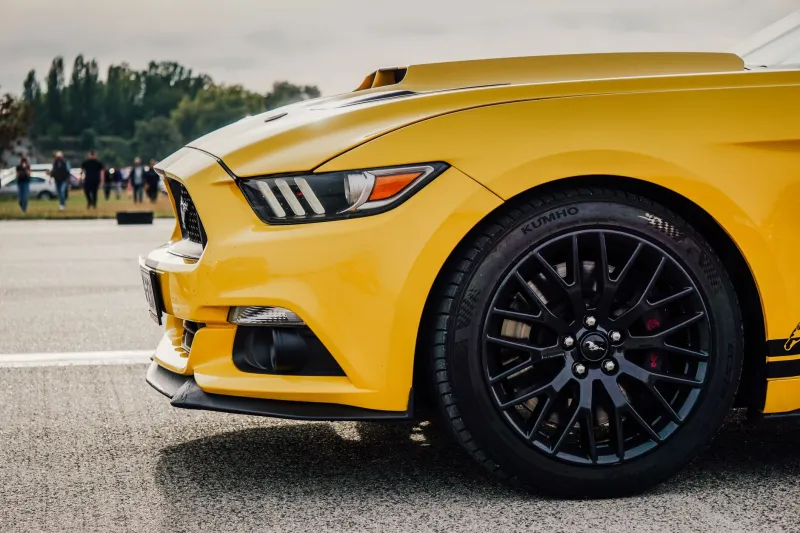
There is a particular kind of automotive enthusiast who will spend months deliberating over engine modifications, exhaust notes, and suspension geometry, yet order whatever tire the dealer happens to stock and consider the matter settled. This is, to put it plainly, a mistake. Not merely a mechanical oversight, but a philosophical one — a failure to understand that the four contact patches pressing against the asphalt at any given moment are, collectively, the most important component on the entire machine.
In grand touring, where the ambition is to cover serious American distance in serious comfort without surrendering serious performance, the tire question is never trivial. It is, in fact, the question — the one that separates the driver who truly understands their car from the one who merely owns it.
The Engineering Reality Beneath Your Feet
To appreciate what a tire actually does, it helps to strip away the marketing language and confront the physics. Every force your car generates — acceleration, braking, cornering — must pass through a contact patch roughly the size of a human hand. That small ellipse of rubber is the only thing mediating between your intentions and the road's indifference.
Tire engineers speak of compounds the way winemakers speak of terroir. The blend of synthetic rubber, carbon black, silica, and proprietary polymers determines how a tire behaves across a spectrum of temperatures, surfaces, and loading conditions. A summer performance tire, engineered for maximum grip in warm, dry conditions, achieves its adhesion through a softer, stickier compound that conforms intimately to road texture. A grand touring all-season tire, by contrast, sacrifices some peak grip in exchange for predictability across a far wider range of temperatures — a trade that makes profound sense on a November drive through the Appalachians but feels like a compromise on a July morning at a track day in the Mojave.
Neither compound is universally superior. Both reflect a set of values. And that, precisely, is the point.
The Psychology of Grip Confidence
Seasoned drivers will tell you that the most important thing a tire provides is not grip itself, but the communication of grip. The finest grand touring tires deliver what engineers call progressive breakaway — a graduated, readable transition from adhesion to slip that allows the driver to sense the approaching limit and respond accordingly. Inferior rubber, by contrast, tends toward sudden, binary behavior: it grips, and then it does not.
This distinction matters enormously on the kinds of roads grand touring enthusiasts actually frequent. On a sweeping two-lane cutting through the Blue Ridge Parkway, or a long descending curve somewhere in the Colorado high country, the driver who can feel exactly where the tire's limit lies is a driver who can use the full capability of their machine with confidence. The driver who cannot feel that limit is either leaving performance untouched or, worse, discovering the limit in the least forgiving possible manner.
The psychological dimension is underappreciated. Confidence in one's tires is not arrogance — it is the precondition for genuine engagement with the road. When you trust your contact patches, your mind is free to read the surface ahead, modulate your inputs, and experience the full dialogue between car and driver. When you do not trust them, you are driving defensively against your own equipment, which is a poor way to spend a grand touring afternoon.
Reading the Sidewall Like a Text
For the uninitiated, a tire's specifications can appear impenetrable — a string of numbers and letters that seems designed to discourage inquiry. In practice, these markings are a remarkably dense summary of a tire's engineering intent.
The speed rating, that single letter buried at the end of the size designation, tells you the sustained speed the tire is certified to handle. For genuine grand touring use on American highways and the occasional spirited back road, a W or Y rating is not vanity — it is assurance that the tire's structural integrity is matched to the performance envelope of the vehicle it serves.
The treadwear rating, meanwhile, is one of the more honest numbers in the automotive world. A tire rated at 140 will wear dramatically faster than one rated at 400. High-performance summer tires often carry low treadwear numbers precisely because the soft compounds that deliver exceptional grip also abrade more readily. This is not a flaw; it is an intentional trade. The enthusiast who understands this is not surprised when their performance rubber requires replacement after 20,000 miles. They budgeted for it, because they understood what they were buying.
The Grand Touring Case for Considered Compromise
Pure performance tires — the track-day-capable, ultra-high-performance summer compounds fitted to the most serious sports cars — are not always the correct answer for grand touring use. The grand tourer, by definition, must cover real distances across real American conditions. A road trip from Nashville to Taos, or from Portland to the California coast, will encounter morning dew, intermittent rain, varying pavement quality, and temperature swings that can span 40 degrees Fahrenheit within a single day.
In this context, the grand touring tire category — a designation used by manufacturers to describe compounds engineered specifically for long-distance, high-speed, all-conditions performance — deserves far more respect than it typically receives. Michelin's Pilot Sport All Season 4, Continental's ExtremeContact DWS06+, and Bridgestone's Potenza Sport A/S represent a tier of engineering sophistication that would have seemed extraordinary even fifteen years ago. These are not compromised tires. They are tires that have internalized the grand touring philosophy: capable of genuine performance when called upon, composed and communicative when conditions demand restraint.
What Your Choice Says About You
Here is the uncomfortable truth that tire conversations tend to avoid: the rubber you choose reflects your actual priorities, not the ones you claim at dinner parties. The enthusiast who mounts the cheapest available replacement tire on a $90,000 grand tourer has made a statement, whether they intended to or not. They have announced that the final interface between their machine and the road — the component that determines whether all that engineering actually reaches the pavement — is an afterthought.
Conversely, the driver who researches compounds with the same rigor they apply to oil selection or brake pad specification is declaring something different. They understand that a car is a system, that every component's performance is contingent on every other component's performance, and that the tire is not the least glamorous link in that chain but rather the most fundamental one.
Engine choices are easy to romanticize. Displacement, cylinder count, forced induction — these things have mythology attached to them. Tires do not. They are round, black, and unglamorous. They are also the reason your car does everything it does.
The Obsession Is Justified
Grand touring, at its most serious, is the pursuit of a particular kind of freedom: the ability to move across this country with authority, comfort, and engagement — to feel the road rather than merely traverse it. That pursuit begins, and in many ways ends, with what you mount at each corner.
The enthusiasts who obsess over tire selection are not being pedantic. They are being precise. They understand that the contact patch is where intention becomes reality, where engineering philosophy meets asphalt, and where the character of a driver is finally and honestly expressed. In a discipline built on the marriage of performance and refinement, there is no more honest confession than the tire you choose to trust with every mile.