The Virtue of Restraint: Discovering What a Grand Tourer Truly Offers When You Ease Off the Throttle
There is a peculiar assumption embedded in the way enthusiasts discuss performance automobiles — that the measure of a machine is found at its extremes. Zero-to-sixty figures are memorized, top speeds are cited like scripture, and the implicit suggestion is always the same: that a car's worth is revealed only when it is being pushed toward some kind of limit. For the dedicated grand touring driver, this assumption deserves a great deal of scrutiny, and ultimately, rejection.
The grand tourer, as a category, was never conceived as a device for the pursuit of maximum velocity. It was conceived as an instrument for the sustained, intelligent traversal of distance — a machine capable of carrying two people and their luggage from one city to another with composure, precision, and a quality of engagement that no ordinary automobile could replicate. Speed was always a component of that equation, never the whole of it.
What happens, then, when a driver approaches a grand tourer not as a performance instrument to be exploited, but as a precision tool to be understood? The answer, for those willing to exercise genuine patience, is revelatory.
The Tyranny of the Redline
Modern automotive culture has developed an unfortunate tendency to conflate excitement with aggression. The track-day mentality — braking late, carrying maximum cornering speed, extracting every fractional second from a given stretch of road — has seeped into the consciousness of enthusiasts who may never set foot on a circuit. The result is a generation of drivers who are genuinely skilled at operating their vehicles at high intensity but who have spent comparatively little time learning what those same vehicles communicate at ordinary, legal speeds.
This is a meaningful loss. A grand tourer driven at its limits on a closed circuit reveals one set of characteristics. The same machine, driven across three states at posted speeds on a mixture of interstate, state highway, and mountain two-lane, reveals something else entirely — something arguably more sophisticated and certainly more useful to a driver who intends to actually live with the car.
The steering weight at seventy miles per hour on a cambered highway tells you something about how the chassis was engineered that a lap time cannot. The way the suspension absorbs a sequence of frost-heaved pavement in rural Vermont, or navigates the undulating blacktop of a Tennessee ridge road, communicates a depth of engineering intent that only emerges over hundreds of miles at varied, moderate speeds.
Surface, Gradient, and the Language of the Road
One of the most compelling arguments for measured, patient grand touring is the sheer variety of information available to a driver who is not preoccupied with velocity. American roads, in particular, offer an almost inexhaustible curriculum in surface variation. The smooth, precisely graded asphalt of a newly resurfaced interstate is one thing. The coarse chip-seal of a rural county road is another. The polished concrete of a southwestern highway, the worn brick of an old urban boulevard, the gravel-dusted switchback descending from a Colorado pass — each surface presents the tires, the suspension, and ultimately the driver with a distinct set of conditions.
A grand tourer worth the designation responds to each of these surfaces differently, and those differences are audible, tactile, and deeply informative. The tire noise changes. The steering feedback shifts. The body motions alter subtly. At elevated speeds, these variations are compressed into a blur of sensation that the brain processes reactively. At measured speeds, they become a genuine conversation between driver and machine.
Gradient adds another dimension. The way a grand tourer manages its weight under sustained elevation gain — whether it breathes easily or labors, whether the transmission hunts or holds its selection with confidence — is information that a flat-road sprint cannot provide. Descending a long grade in the southern Appalachians with engine braking engaged, feeling the chassis settle and the brakes thermally stabilize, teaches a driver something about their car's engineering that cannot be extracted from a standing-start acceleration run.
Patience as a Driving Philosophy
The philosophical shift required to fully appreciate a grand tourer is not complicated, but it does demand a genuine reorientation of priorities. It requires the driver to accept that the goal of a given journey is not the fastest possible completion, but the richest possible experience of the distance between departure and arrival.
This is not a passive or inattentive mode of driving. It is, in many respects, more demanding than aggressive performance driving, because it requires sustained, deliberate engagement rather than reactive intensity. The driver must remain present to subtle inputs — the slight understeer that develops as tire temperatures rise on a long sweeper, the chassis flex that becomes perceptible on a rough two-lane, the way the engine note changes pitch as altitude increases and air density decreases.
These are not dramatic sensations. They do not produce the visceral thrill of a full-throttle acceleration run. But they accumulate, over the course of a long drive, into a comprehensive and intimate understanding of the vehicle that no other form of driving can replicate. Drivers who develop this understanding become genuinely more capable behind the wheel, not because they have learned to drive faster, but because they have learned to drive with greater precision and awareness.
What the Miles Actually Reveal
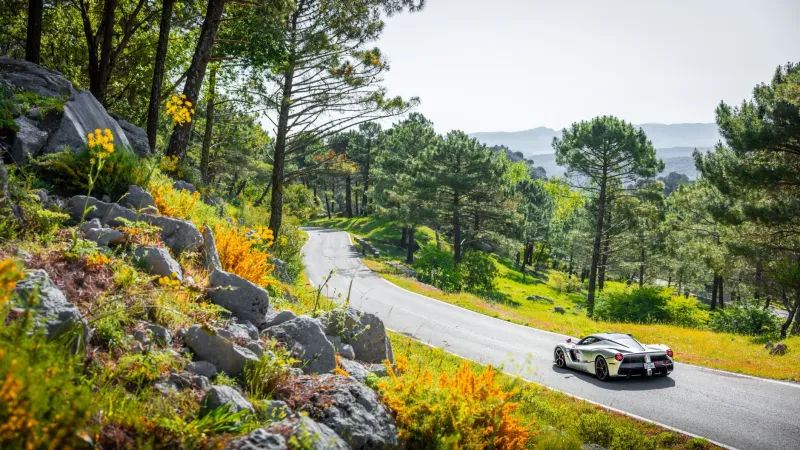
There is a reason that the classic grand touring routes of the American West — US Route 50 across Nevada, the Blue Ridge Parkway threading through Virginia and North Carolina, the Pacific Coast Highway from Carmel to Malibu — have retained their appeal to serious enthusiasts for generations. These roads are not racetracks. They are not particularly fast. What they are is varied, demanding in a specific and rewarding way, and long enough to reveal a vehicle's true character across a genuine range of conditions.
A driver who completes the full length of the Blue Ridge Parkway in a well-chosen grand tourer, maintaining appropriate speeds and remaining genuinely attentive to what the car is communicating, will finish the journey knowing that machine in a way that ten track sessions could not produce. They will understand its weight distribution in a visceral, embodied way. They will have felt the chassis work through hundreds of distinct surface transitions. They will have experienced the powertrain across a genuine range of loads and gradients.
This is the education that grand touring, at its best, provides. It is slow by the standards of motorsport. It is legal by the standards of the road. And it is, for the driver genuinely committed to understanding what they are operating, profoundly more illuminating than any pursuit of a faster number.
The grand tourer was built for the long road, not the short sprint. Respecting that distinction is not a concession to timidity. It is the beginning of genuine mastery.