Old Bones, New Soul: How America's Restomod Builders Are Reinventing the Classic Grand Tourer
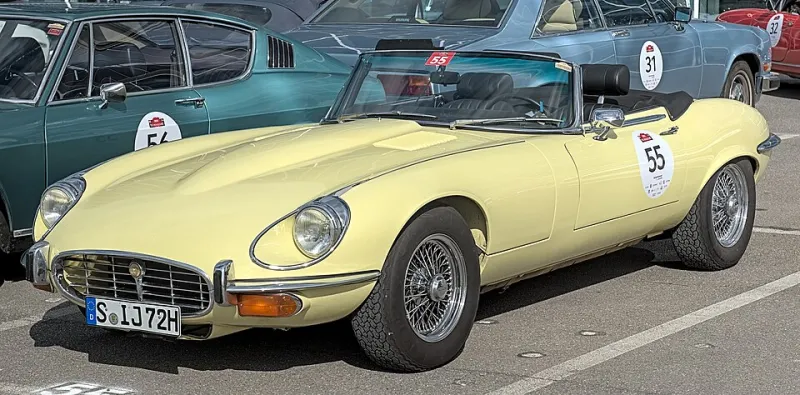
Photo: Alexander Migl, CC BY-SA 4.0, via Wikimedia Commons
In a climate-controlled workshop in Southern California, a 1967 Jaguar E-Type is undergoing a transformation that its original designers could not have imagined. The sinuous Pininfarina-inspired bodywork remains intact—every curve preserved with obsessive fidelity—but beneath that legendary skin, the original straight-six has given way to a modern, fuel-injected engine. The dashboard now integrates a discreet touchscreen. The suspension geometry has been recalibrated using computational tools that did not exist when the car was new. When it is complete, it will be faster, more reliable, and more comfortable than any factory-original example. Whether it will be more authentic is a question that depends entirely on whom you ask.
This tension sits at the heart of the restomod movement, a discipline that has evolved from backyard hot-rodding into one of the most sophisticated and commercially significant sectors of the collector car world. And nowhere is that evolution more pronounced than in the realm of the classic grand tourer, where the stakes—aesthetic, mechanical, and philosophical—are highest.
Defining the Discipline
The term "restomod" has always carried a certain imprecision. In its broadest sense, it describes any vehicle that has been restored to presentable condition while incorporating modifications beyond the original factory specification. In practice, the word now encompasses a spectrum that runs from a tastefully upgraded 1970s muscle car to a comprehensively re-engineered European grand tourer that shares little with its donor vehicle beyond its body panels.
The latter category is where the most serious contemporary work is being done, and where the most searching questions about the nature of automotive authenticity arise. A restomod E-Type or early 911 is not a preservation project. It is an argument—a carefully constructed case that these cars, magnificent as they were, can be made substantially better by the application of modern engineering.
For purists, this argument is heretical. The imperfections of a period-correct classic—the vague steering, the unreliable electrics, the engine that requires coaxing on cold mornings—are not flaws to be corrected. They are characteristics to be understood and accepted, part of the authentic experience of owning a piece of automotive history. To eliminate them is to produce something that resembles the original without honestly being it.
For the restomod community, this position mistakes inconvenience for authenticity. The engineers who designed the E-Type were working at the absolute frontier of what was technically achievable in 1961. Had they possessed access to modern materials, manufacturing techniques, and electronic systems, they would have used them. The restomod, in this view, completes the original designer's intention rather than betraying it.
The Shops Defining the Conversation
Several American builders have emerged as the most articulate practitioners of this philosophy, their work setting a standard that has attracted international attention and, in some cases, waiting lists measured in years.
Eagle Continuation Cars, though British in origin, has found a devoted American clientele for its reimagined E-Types—cars that begin with genuine Jaguar bodies and emerge as something the company describes as "the E-Type as it would be built today." The approach is methodical and uncompromising: every system is evaluated, retained if it meets a demanding standard of performance and reliability, and replaced if it does not.
In the United States, Singer Vehicle Design remains the most prominent name in high-end restomod culture, its Porsche 911-based creations having achieved a cultural status that few workshop products in any field can claim. A Singer commission—which begins with a donor 964-generation 911 and ends with what the company calls a "reimagined" vehicle—costs well into six figures and represents an unambiguous statement about the owner's priorities. The waiting period alone communicates the seriousness with which Singer's work is regarded.
Less celebrated but equally rigorous, Californian builder Gunther Werks has pursued its own interpretation of the reimagined 993-generation 911, producing cars with carbon fiber body panels, bespoke suspension components, and naturally aspirated flat-six engines producing outputs that the original factory would have found extraordinary. The result is a car that looks, from a distance, like a lightly modified period example—and drives, by all accounts, like nothing else on the road.
On the East Coast, firms such as Radford Motors and several smaller specialist operations have begun applying comparable philosophies to British marques, finding in the American market an appetite for reimagined Aston Martins and Lotus grand tourers that the domestic UK market has been slower to develop.
What Makes a Restomod Succeed—or Fail
Not every restomod is a Singer. The discipline has its share of poorly executed examples—cars that combine the worst of two eras rather than the best, that sacrifice the original's driving character in pursuit of convenience features, or that present as expensive while delivering mediocrity.
The distinction between a successful restomod and an unsuccessful one often comes down to a single quality: restraint. The most admired builds in this space are those in which the modifications serve the driving experience rather than advertising the builder's capabilities. A modern braking system installed beneath period-correct wheel covers. An engine management system that delivers contemporary reliability without altering the character of the original powerplant. Climate control integrated so seamlessly into the dashboard that it appears to have always been there.
Conversely, the builds that earn the widest criticism are those in which the modifications overwhelm the original character—where a vintage grand tourer has been fitted with a contemporary infotainment system that dominates the cockpit, or where the suspension has been stiffened to a degree that eliminates the long-distance comfort that defined the original car's purpose.
"The car has to still feel like itself," says Marcus Dellano, a Colorado-based collector who owns both a period-correct 1969 Porsche 911 S and a Singer-reimagined example. "If you drive a restomod and forget what you're sitting in, something has gone wrong. The best ones remind you constantly of the original—but they also remind you why you wanted a better version of it."
The Market's Verdict
Whatever the philosophical debate, the commercial reality of the restomod market is unambiguous. Demand for high-quality reimagined grand tourers in the United States has grown consistently over the past decade, driven by a generation of affluent enthusiasts who came of age admiring these classics but have no appetite for the maintenance challenges and performance limitations of unmodified originals.
For this buyer, the restomod resolves a genuine tension. It delivers the visual and emotional connection to automotive history that a modern vehicle cannot provide, while meeting the practical and performance expectations that contemporary life demands. It is, in a sense, the ultimate expression of the grand touring philosophy: a machine engineered to cover ground beautifully, reliably, and with the maximum possible engagement between driver and road.
Whether that machine should carry its original engineering intact or benefit from six decades of subsequent progress is, ultimately, a question each enthusiast must answer for themselves. The restomod movement simply argues, with considerable conviction and some spectacular evidence, that the answer need not be obvious.